


You are using an out of date browser. It may not display this or other websites correctly.
You should upgrade or use an alternative browser.
You should upgrade or use an alternative browser.
Absurdism corner
- Thread starter Bosbeetle
- Start date

Null
Snug

Null
Snug

Null
Snug
Null
Snug

Null
Snug

Null
Snug

Null
Snug
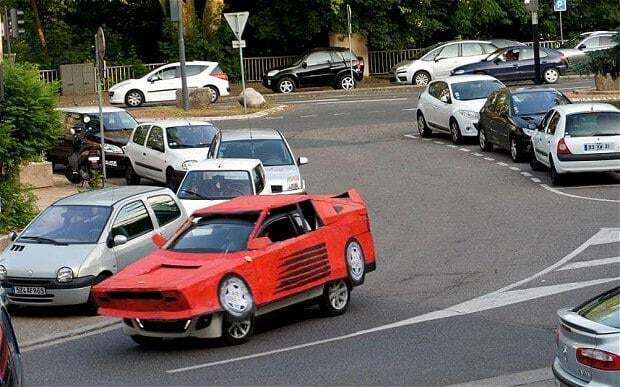
Seems legit.

TeDaDeS
Forum Addict!
- Joined
- Jan 15, 2004
- Messages
- 3,090
Sometimes you think you know some of the basics, like what water is. Humans mostly consist of water, right? 
Water is usually known to have 3 phases: solid (ice), water (liquid), gas (water vapor in air).
Ice was already found to have much more distinct phases, 20 at the moment.
In 1992 the idea was raised water in a liquid state also has 2 phases, and it looks like this is now proven to be probably true.
The two phases are high-density liquid (HDL) and a low-density liquid (LDL) depending on the temperature, and these states are mixed due to the unique properties of hydrogen bonds. (bond... hydrogen bond! starts the james bond theme song)
This is likely the cause of liquid water behaving differently from other liquids.
Some of the research has been performed using AI which was done this year: https://www.zmescience.com/science/...s-evidence-in-74-million-molecular-snapshots/
"Water exhibits a variety of anomalous behaviours. To date, many computer simulations and experimental studies have shown compelling evidence for the existence of a liquid–liquid phase transition between the high-density and low-density phases in the deeply supercooled regime and for a critical point that terminates the boundary between the two phases. A possible theoretical scenario concerning the origin of these anomalies is the two-state model of water, which posits that water is composed of two distinct and interconvertible local structures. Here we identify multidimensional reaction coordinates that can provide molecular-level evidence for the generic existence of two local structures undergoing interconvertible reactions in liquid water. By employing unsupervised deep learning on massive molecular dynamics simulations of an accurate and widely used water model, we found that near the high-density/low-density phase boundary, interconvertible reactions proceed via a full-loop reaction pathway with three saddle points, whereas away from it the reactions proceed via a semi-loop pathway with a single saddle point. These findings provide molecular-level evidence in support of the two-state water model and may offer physical insights into the origin of the liquid–liquid phase transitions more generally."
source: https://www.nature.com/articles/s41567-026-03301-8
"The fascinating hypothesis that supercooled water may segregate into two distinct liquid phases, each with unique structures and densities, was first posited in 1992. This idea, initially based on numerical analyses with the ST2 water-like empirical potential, challenged the conventional understanding of water’s phase behaviour at the time and has since intrigued the scientific community. Over the past three decades, advancements in computational modelling—particularly through the advent of data-driven many-body potentials rigorously derived from first principles and augmented by the efficiency of neural networks—have greatly enhanced the accuracy of molecular simulations, enabling the exploration of the phase behaviour of water with unprecedented realism. Our study leverages these computational advances to probe the elusive liquid–liquid transition in supercooled water. Microsecond-long simulations with chemical accuracy, conducted over several years, provide compelling evidence that water indeed exists in two discernibly distinct liquid states at low temperature and high pressure. By pinpointing a realistic estimate for the location of the liquid–liquid critical point at ~198 K and ~1,250 atm, our study not only advances the current understanding of water’s anomalous behaviour but also establishes a basis for experimental validation. Importantly, our simulations indicate that the liquid–liquid critical point falls within temperature and pressure ranges that could potentially be experimentally probed in water nanodroplets, opening up the possibility for direct measurements."
source: https://www.nature.com/articles/s41567-024-02761-0
Water is usually known to have 3 phases: solid (ice), water (liquid), gas (water vapor in air).
Ice was already found to have much more distinct phases, 20 at the moment.
In 1992 the idea was raised water in a liquid state also has 2 phases, and it looks like this is now proven to be probably true.
The two phases are high-density liquid (HDL) and a low-density liquid (LDL) depending on the temperature, and these states are mixed due to the unique properties of hydrogen bonds. (bond... hydrogen bond! starts the james bond theme song)
This is likely the cause of liquid water behaving differently from other liquids.
Some of the research has been performed using AI which was done this year: https://www.zmescience.com/science/...s-evidence-in-74-million-molecular-snapshots/
"Water exhibits a variety of anomalous behaviours. To date, many computer simulations and experimental studies have shown compelling evidence for the existence of a liquid–liquid phase transition between the high-density and low-density phases in the deeply supercooled regime and for a critical point that terminates the boundary between the two phases. A possible theoretical scenario concerning the origin of these anomalies is the two-state model of water, which posits that water is composed of two distinct and interconvertible local structures. Here we identify multidimensional reaction coordinates that can provide molecular-level evidence for the generic existence of two local structures undergoing interconvertible reactions in liquid water. By employing unsupervised deep learning on massive molecular dynamics simulations of an accurate and widely used water model, we found that near the high-density/low-density phase boundary, interconvertible reactions proceed via a full-loop reaction pathway with three saddle points, whereas away from it the reactions proceed via a semi-loop pathway with a single saddle point. These findings provide molecular-level evidence in support of the two-state water model and may offer physical insights into the origin of the liquid–liquid phase transitions more generally."
source: https://www.nature.com/articles/s41567-026-03301-8
"The fascinating hypothesis that supercooled water may segregate into two distinct liquid phases, each with unique structures and densities, was first posited in 1992. This idea, initially based on numerical analyses with the ST2 water-like empirical potential, challenged the conventional understanding of water’s phase behaviour at the time and has since intrigued the scientific community. Over the past three decades, advancements in computational modelling—particularly through the advent of data-driven many-body potentials rigorously derived from first principles and augmented by the efficiency of neural networks—have greatly enhanced the accuracy of molecular simulations, enabling the exploration of the phase behaviour of water with unprecedented realism. Our study leverages these computational advances to probe the elusive liquid–liquid transition in supercooled water. Microsecond-long simulations with chemical accuracy, conducted over several years, provide compelling evidence that water indeed exists in two discernibly distinct liquid states at low temperature and high pressure. By pinpointing a realistic estimate for the location of the liquid–liquid critical point at ~198 K and ~1,250 atm, our study not only advances the current understanding of water’s anomalous behaviour but also establishes a basis for experimental validation. Importantly, our simulations indicate that the liquid–liquid critical point falls within temperature and pressure ranges that could potentially be experimentally probed in water nanodroplets, opening up the possibility for direct measurements."
source: https://www.nature.com/articles/s41567-024-02761-0
Null
Snug

Null
Snug
TeDaDeS
Forum Addict!
- Joined
- Jan 15, 2004
- Messages
- 3,090
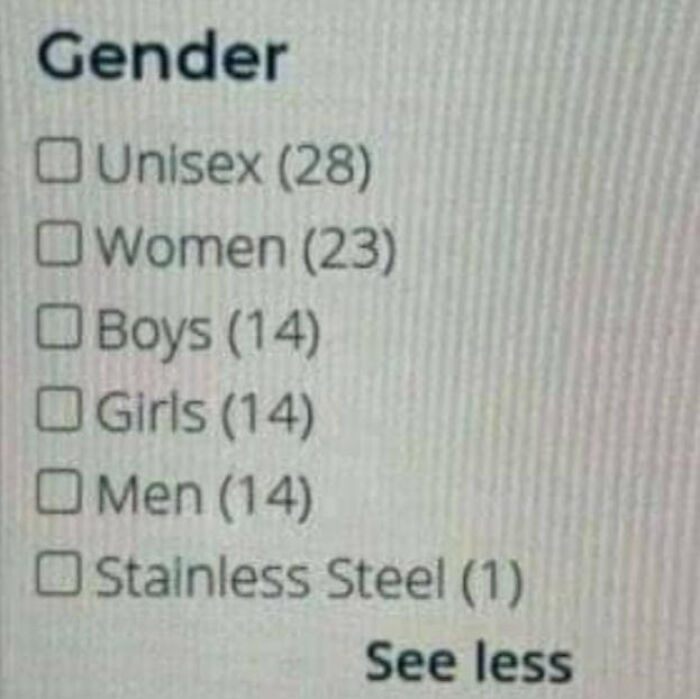
Obviously it's the filter for the selection of underwear on some shopping website.

Null
Snug

Null
Snug
Null
Snug
Null
Snug

Null
Snug
Null
Snug
Null
Snug

Null
Snug

Similar threads


- Replies
- 29
- Views
- 8K
